Rep. Andy Barr seems to have a safe seat. So why all the attack ads against Josh Hicks?
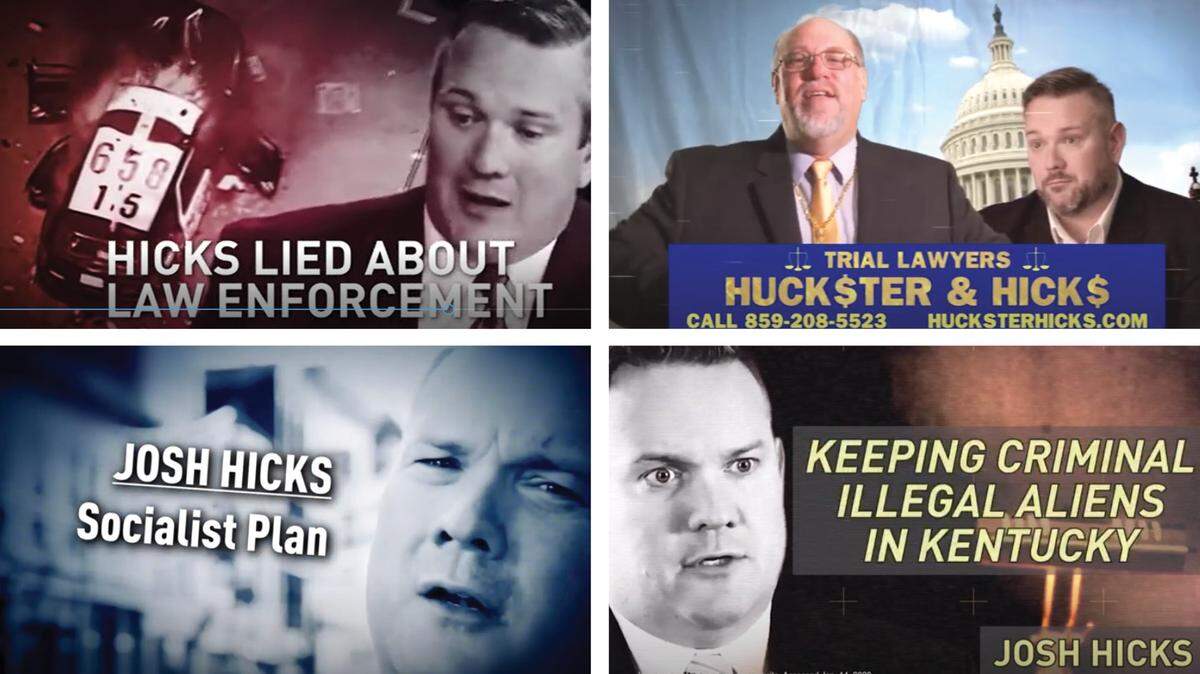
On Thursday, Republican U.S. Rep. Andy Barr of Lexington launched his ninth attack ad in a little over a month on Democratic challenger Josh Hicks. This ad tries to link Hicks, a former U.S. Marine and Maysville police officer, with “radical mobs ... tearing down the America we love.”
“Police have been beaten, abused and assaulted,” a male narrator says over images of a burning American flag and police scuffling with protesters in city streets. “And Josh Hicks promotes the mob’s lie that all police are racist.”
Hicks hasn’t said “all police are racist.” In June, he said on KET that, in his experience, there is “systemic racism” in law enforcement because minority neighborhoods are policed differently than largely white areas.
But this has not been a season for subtlety. Instead, political experts around Central Kentucky’s 6th Congressional District say they’ve been startled by the relentless kidney punches of Barr’s campaign given his presumed lead over Hicks in the race.
“It’s weird,” said John Heyrman, a political scientist at Berea College. “Andy Barr is the incumbent and he won last time against a much better known, better funded opponent, Amy McGrath. So it is surprising that he would spend so much time and money to go so negative so quickly.”
“He must be a little bit worried,” Heyrman said. “I haven’t seen any polling in this race, but the Democrats are expected to do well generally this year.”
Don Dugi, a political scientist at Transylvania University, said he is “taken aback” by the intensity and negativity of the ads. “It just feels like these blatant attacks — and there’s clearly a lot of falsehoods in them — they’re in our faces every time we turn on the TV.”
In a barrage of television commercials arriving twice weekly, Barr has accused Hicks of being a “socialist” who would force Kentuckians to wait in line for life-saving medical treatment; supporting taxpayer-funded abortion up to the moment of birth; wanting to tax Kentuckians $1,000 for each of their children; and “keeping criminal illegal aliens in Kentucky,” among other alleged offenses.
For one commercial, Barr hired an actor to portray Hicks’ law partner at the fictitious firm of “Huckster & Hicks,” mocking his work as an attorney. (“We’re trial lawyers!” the actor chortles. “We’ll sue anyone for big bucks!”) Barr even established a phone number and website for the fake firm promoted in the ad to direct viewers to more anti-Hicks messages.
In its latest finance report, covering the three-month period of July 1 through Sept. 30, the Barr campaign said it spent $1.4 million on advertising. It also disclosed $20,000 on fees to an opposition research firm that specializes in “actionable intelligence for a rapidly changing competitive landscape.”
Barr, speaking Thursday at a Nicholasville auto parts factory where he helped announce a $10.5 million federal CARES Act loan, said his attacks are routine campaign fare.
“We highlight the differences between the candidates,” Barr said. “We highlight the differences between my record of fighting and getting results, like this announcement here today, and the differences in terms of the values and priorities of our opponent. That’s natural. That’s a normal thing.”
In response, Hicks said Barr is slinging so much mud this fall because he doesn’t have a lot else to offer.
“After years of voting to take away your health care and prioritizing policies that help the top 1 percent of Americans and wealthy corporations, all that’s left for him to campaign on is lies,” Hicks said.
“He has lost any pretense of accountability for his words or actions,” Hicks said. “If he’ll lie about me this way in public, imagine what he’ll say about you behind closed doors.”
Barr’s strategy has thrown Hicks on the defensive while he’s been trying to introduce himself to Central Kentucky. Some of his own ads have been responses to Barr’s attacks. After a Barr ad accused Hicks of insulting police, Hicks ran an ad reminding voters that he has served his country as a Marine and a police officer.
“Barr doesn’t get to disrespect my service,” a scowling Hicks told the camera.
Election Day is Nov. 3, but early voting already is underway across Kentucky.
Is Barr losing Trump’s coattails?
The Herald-Leader spoke with political scientists following the 6th Congressional District race at Berea College, the University of Kentucky, Transylvania University and Eastern Kentucky University. All said they were surprised that most of Barr’s ads so prominently feature his opponent, rather than himself.
Barr, a four-term congressman with access to fundraising from Washington’s political action committees, has more campaign cash than Hicks. He has raised $3.9 million against Hicks’ $2.4 million (although the two men did about the same in the most recently reported quarter, ending Sept. 30, each raking in a little more than $1 million).
Political websites Sabato’s Crystal Ball and The Cook Political Report rate the 6th District as “likely Republican,” suggesting that Barr should not be in danger of losing his seat.
“Normally, a contest like this would be a cakewalk. A member of the House wouldn’t need to invest so much energy in the election, much less be talking all the time about the person running against him,” said Stephen Voss, who studies political methodology and voting behavior at UK.
The problem for Barr, Voss said, is that Republican President Donald Trump appears to be struggling in his own re-election fight against Democrat Joe Biden.
Trump carried the 6th Congressional District by a 15-point margin in 2016. But this fall, he might not be able to share the overwhelming momentum he once did with Barr and other Republican politicians, Voss said.
“What we’re seeing here is a recognition that what’s going on at the top of the ticket filters down to other races,” Voss said.
“This is a district that does have the potential to swing back toward the Democrats in an election year that’s extremely favorable for that party. And this year, all the signs are extremely favorable for Democrats across the slate,” Voss said.
Barr wants to personalize his attacks on Hicks so wavering voters who are unhappy with the state of things in 2020 won’t consider Hicks to be a viable alternative, said Dugi at Transylvania University.
“You could simply say ‘my opponent’ or ‘the Democrats,’ and that’s what the incumbents usually do,” Dugi said. “You try not to name the other guy.”
“But all of this clearly has been personal attacks. It’s one of those deals where they’re going after someone with a bazooka instead of a fly swatter. They do seem a little scared they won’t have Trump’s coattails this time. I suspect that’s part of the thinking here,” Dugi said.
Reaching ‘low-information voters’
Although everyone says they hate the mud-slinging in attack ads, politicians often resort to those tactics because they suspect it can shift crucial votes their way, the political scientists said.
Steve Barracca at EKU said the 6th District is “purplish,” neither a predictable conservative red nor liberal blue. It has swung back and forth between Democratic and Republican congressmen over the last 25 years. So if Barr fears that voters are in the mood for a change, “he’s not going to take anything for granted,” Barracca said.
Attack ads aren’t aimed at active Republicans and Democrats who read the news and pick their candidates early, Barracca said.
“With negative advertising, you’re trying to persuade low-information voters and undecideds, people who don’t follow politics closely,” Barracca said. “They’re looking for any sort of cues, and the attacks, the negative impressions, do have an impact on them. People don’t want to vote for someone who might be corrupt or scandal-ridden. So that’s who you’re trying to reach with these things.”
Heyrman, at Berea College, said he briefly hoped that voters would stop having to suffer through “all these ads yelling at us” in 2002, when Congress passed the Bipartisan Campaign Reform Act.
One part of the reform law requires candidates to personally vouch for their broadcast advertising. Hence, the final seconds of each ad where candidates appear on screen, say their name and declare “I approve this message.”
“Naively, I guess, I thought that would cause people to be a little more hesitant to go on the air and make all these scurrilous attacks. Because now you had to stand there and put your name on it,” Heyrman said, chuckling. “Clearly I was wrong about that.”
This story was originally published October 16, 2020 at 2:23 PM.